


Recommended product


wet cement is easy to remove with water and soap?
How to remove cement stains? View our tips
Cement residues, often resulting from accidental spills or splashes during construction tasks, can lead to unsightly stains that are difficult to remove. To prevent these issues, using preventive measures like plastic sheets can be effective. However, once stains occur, removing them from tiles requires careful approach.
While DIY methods such as vinegar solutions or sandpaper can be used, they often do not guarantee success and may damage surfaces, especially calciferous stones like marble. For safe and effective removal, HG tile cement grout and mortar remover is recommended. It efficiently dissolves cement without harming grout, suitable for non-calciferous surfaces like Norwegian slate and granite. Discovering the nuances of these solutions might change how you handle cement stains forever.
HG tile cement grout and mortar remover to remove cement stains
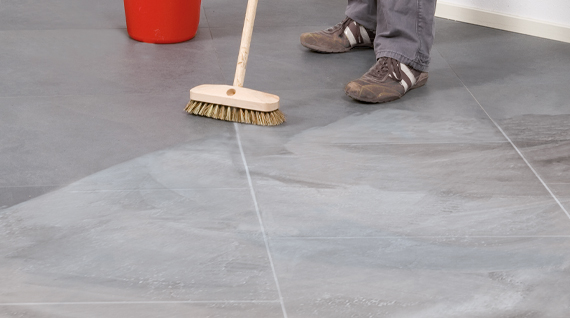 Products, such as vinegar, sandpaper or a scraper, are convenient as an emergency solution but they are not always terribly effective. They can also damage the surface. With HG tile cement grout and mortar remover you remove cement stains quickly, safely and effectively. The cement is dissolved, but the cement from the grouting remains intact and is even strengthened.
The product removes efflorescence and mortar stains from porous and non-porous ceramic tiles and flagstone and is also suitable for non-calciferous natural stone. Including Norwegian slate, granite and quartzite.
HG tile cement grout and mortar remover cannot be used for calciferous natural stone, such as marble, travertine, bluestone, various types of slate and concrete tiles or concrete floors. For those you need HG natural stone cement grout film remover.
This is how you use HG tile cement grout and mortar remover to remove cement stains and mortar residues:
First clean the surface that requires treatment with clean water.
Dissolve half a litre of HG tile cement grout and mortar remover in 5 litres of water.
Then apply the solution liberally with a mop or floor cloth.
Scrub the stains with a scrubbing brush or stiff broom.
Leave to absorb for a few minutes and then scrub properly once more.
Then mop up the solution and wring out the mop regularly.
The most common causes of cement residues and how to prevent them

How to remove cement from tiles: 2 DIY tips
Various tips are shared on the internet on how to remove cement residue from tiles. HG has a selected a number on your behalf. You can try to use these to remove cement or mortar residues.
Remember, these are DIY tips. Use these products with caution and test them in advance. If you want to remove cement stains safely and effectively and strengthen your grout at the same time, use HG tile cement grout and mortar remover.
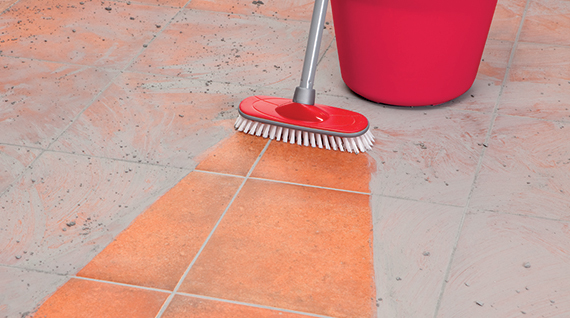 1. Remove cement stains or mortar with vinegar
Cement on a floor dissolves in acid, so that's why you can use vinegar. Be very careful with calciferous stone types, such as marble. Marble can be affected by acid. Silicone edges, in the bathroom for example, can also be damaged by vinegar.
Try to remove the cement stains or mortar residue with one part vinegar and one part warm water. Then you brush this solution onto the surface. Leave to absorb and then rinse with clean water.
2. Remove cement stains with sandpaper or a scraper
Depending on the type of surface, you can remove cement stains and mortar stains with sandpaper or a scraper. It is not possible to remove cement from bricks or other rough stones with sandpaper, but you can treat wood or other surfaces with sandpaper. Really smooth surfaces, such as bathroom tiles or mirrors, are treated with a scraper.
How do I avoid cement stains after grouting?
Frequently Asked Questions about removing cement stains
You can prevent some cement stains with the right preparation. Make sure you have enough room to move and always put down a plastic sheet.
Find a store nearby
Enter a location
Enter your city, postcode or address, or click on the map to find a store near you.
Please note: Not all stores carry the full range.
HG is available at, among others, these stores and webshops:


Other tips for Tough Job & DIY


How to remove oil from driveway


Have a chance to win £70 worth of HG products
